
Neuroplastic pain and its treatment
People often ask me why understanding the role of the brain is so important in the process of curing chronic pain. It’s the first step you can take, it gives you hope. You will see that you are not broken and understand that there is a way out of chronic pain and the solution is in your hands. It is not necessary to understand the details, but understanding the basic principles is useful in the beginning.

Pain as protector and warning signal
Pain is a warning signal announcing danger. If you run and twist your ankle, you will feel the pain so you don’t keep running because it could make your injury worse. If you burn yourself on a hot plate, you will also feel the pain so that you flinch away from burning yourself even more. Pain is our protector.

All pain originates in the brain
Although you may have thought that pain originates in the place where we feel it, this is not the case. All pain originates in the brain. And the job of the brain is to ensure our survival. If it assesses that we are in danger, it wants to let us know in order to protect us. But the brain does not keep up with the times and cannot write a message on messenger or whatsapp. And so it uses its own communication signals, such as pain or anxiety.
The brain can turn pain on and off
Our brain has complex mechanisms that decide whether to turn on pain or not. If you twist your ankle while running away from a tiger, your brain probably won’t turn on pain. Why? Simply because a tiger is a greater danger than an injured ankle. The purpose of the brain is for us to survive. On the other hand, if you twist your ankle during a simple morning jog, your brain will likely trigger a severe pain signal to stop, rest, and prevent further injury. The brain evaluates what is more important to pay attention to based on what is more dangerous.

Pain is not always caused by tissue damage
When you’re in pain, you probably start to wonder if you’ve hurt yourself. But pain is not always caused by tissue damage. Have you heard of phantom pain? Amputees feel pain in the limbs they no longer have. There is no tissue damage. So what causes the pain? Nerve pathways in the brain and their higher sensitivity.
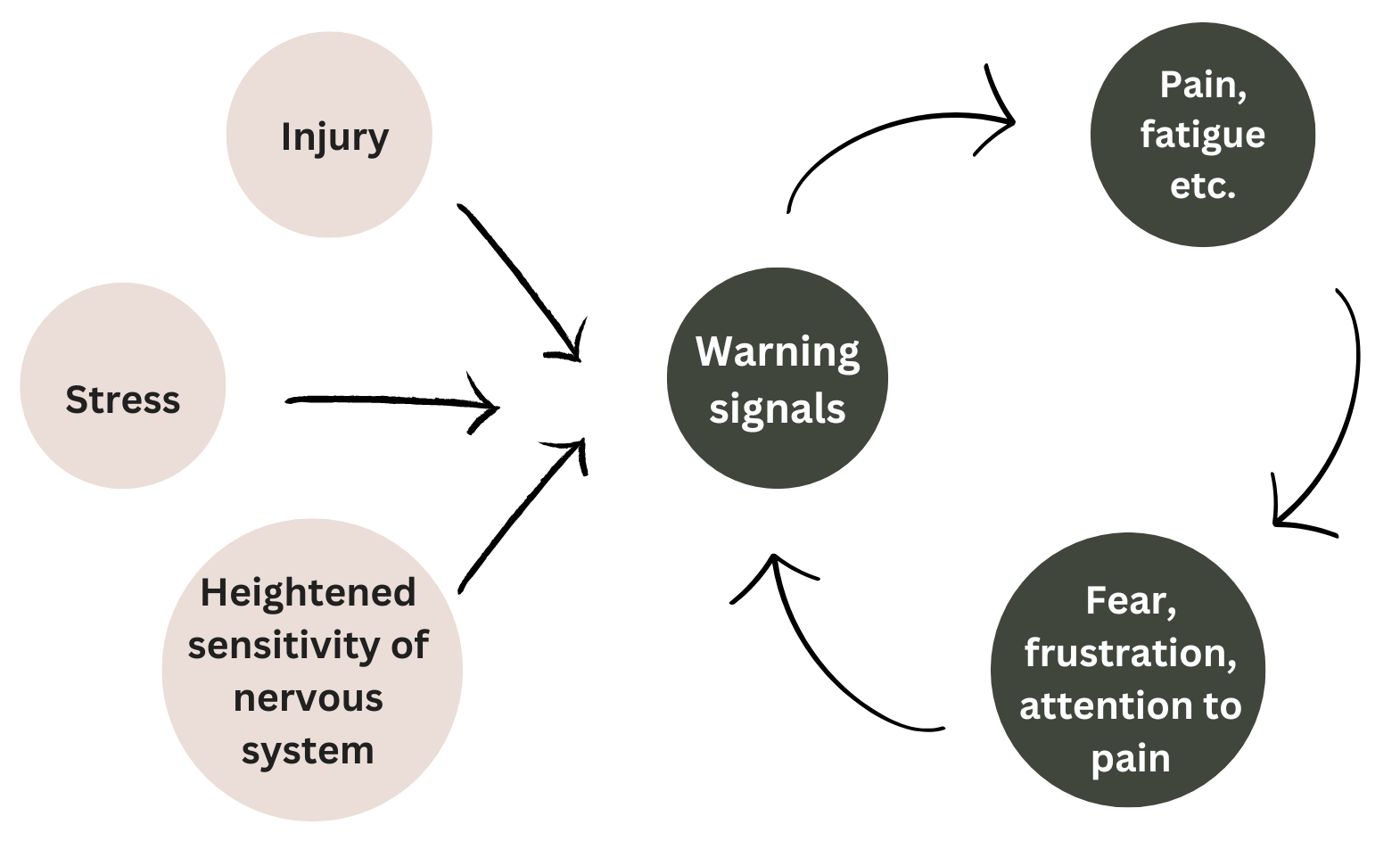
Research also shows that stress and emotions (such as an argument with a partner, anger or sadness) activate the same danger signal as when you suffer a physical injury. Have you ever had a stomach ache from stress before an exam or an important meeting? Have you ever had a headache after a long, emotionally charged day? Emotions cause physical reactions in the body. The result is the same pain, real pain. No, it really isn’t just ‘in your head’.
Pain is not just “in your head”
We already know that the brain cannot distinguish between physical (a tiger) and psychological danger (fear from an exam). In the same way, it also perceives the danger that is only in our imaginations. Remember, there’s a lot at stake. It’s about life. The brain’s main goal is for us to survive. The brain does its job very honestly, and so any hint of danger, even if only in our imagination, it simply evaluates as danger. But sometimes the brain makes mistakes.
Thanks to neuroplasticity, we can learn to walk, for example. Imagine that at the beginning you have only a weak connection between the nerve cells, like a forest path, and gradually that connection strengthens and a highway is created there. And that way you get better at executing the given skill and it happens more automatically with time. Unfortunately, the brain can also learn pain in this way. The brain cannot distinguish whether it is learning something useful or not.
Nerve pathways and their sensitization
In addition, previous life experiences can also contribute to developing painful conditions. Emotional stress not only from childhood can cause your nervous system to become hypersensitive. Such a system then behaves too actively. People with adverse childhood experiences such as physical, sexual, or emotional abuse, parental divorce, neglect, and difficulties at school are statistically more likely to develop chronic pain conditions.
Unfortunately, many doctors are still not sufficiently familiar with the current neuroscience of pain. And so in doctor’s offices and hospitals, the solution is often to alleviate the symptoms of pain, instead of identifying and treating the root cause.
What is the natural response to pain? Fear, frustration, anger. Unfortunately, it is precisely these responses that reinforce the neural pathways that create pain. This creates a vicious circle of pain and fear from which it is not easy to get out.
Can chronic pain be eliminated?
YES! Just as your brain has learned to create pain, it can also unlearn it. Thanks to neuroplasticity, we can work together to weaken those neural connections that create pain. Using the Freedom From Chronic Pain methods, we activate the conscious part of the brain to suppress the subconscious pathways that produce and maintain pain.
Neuroplastic pain
Neuroplastic pain* is pain caused by learned neural pathways in the brain. These pathways are not the result of ongoing structural damage or disease in the body.
Neuroplastic pain arises as a result of changes in the nervous system. Unlike acute pain, which is usually a response to a specific injury or inflammation, neuroplastic pain persists even after the original cause of the pain has been removed or cured.
The brain misinterprets safe signals from the body as dangerous, thereby causing neuroplastic pain or symptoms unexplained by conventional medicine.
A large portion of chronic pain is neuroplastic pain.
This type of pain is associated with a phenomenon called neuroplasticity. Neuroplasticity is the ability of the nervous system to change its activity in response to experience and learning by reorganizing its structure and function. Neuroplastic pain is essentially an unhelpful brain habit that can be unlearned.
Neuroplastic pain can develop as a result of various factors that keep the nervous system on high alert (fight or flight response) and activate neural pathways associated with pain. These factors are, for example, fear, long-term stress, unprocessed emotions, trauma and adverse experiences from childhood or certain personality traits (perfectionism, self-criticism, fear, etc.).
These stimuli, which the brain evaluates as dangerous, can cause changes in the central nervous system, leading to increased sensitivity of the nerves or to disturbances in the transmission of pain signals. One key mechanism is a process called “sensitization,” which causes nerve cells to become hypersensitive to painful stimuli and may respond more strongly than usual. In practice, this means that over time even a small stimulus is enough to cause great pain.
The Freedom From Chronic Pain method can recognize the factors that keep the brain on alert and thus the body in pain.
* also referred to as nociplastic pain, primary pain, MBS (mindbody syndrome), neural circuit pain (pain caused by nerve pathways), PPD (psychophysiologic disorder), PDD (percieved danger pain), TMS (tension myositis syndrome)
Say goodbye to pain
I will help you discover your power and get rid of chronic pain. Just write to me at adele@cestazchronickebolesti.cz or fill in the form.
Contact details will only be used to process your therapy inquiry and will not be used for any other purposes.
